The Power of the Pause
Tori DePrey ’18 shares how resilience, grace, and self-awareness have shaped her evolving nursing journey.
Badger Nurse Spotlight Recent Graduate: Tori DePrey ’18, DNP, MBA, RN

Tori DePrey ’18, DNP, MBA, RN, initially thought she wanted to become a physician’s assistant. But, as she began volunteering at United Hospital in Minneapolis delivering a coffee cart and giving hand massages to patients, her interactions with patients and staff quickly showed her the professionalism and poise that nurses bring to their jobs every day. “I knew nursing was the right fit for me,” DePrey said.
Raised in the Twin Cities, DePrey was considering a handful of nursing programs across the country. But one campus visit to UW–Madison was all it took to solidify her choice to become a Badger. “I instantly knew this was home,” she said. “The blend of a lakeside campus paired with a top-tier academic space hit home.”
DePrey was admitted into the UW–Madison School of Nursing, and though she admits it was challenging at times, she values the experiences and nursing education she received in top-notch facilities. “The program was challenging, but informative,” she said, adding, “Signe Skott Cooper Hall quickly became a second home where my nursing friends and I spent many hours studying.”
DePrey pursued critical care after graduating, starting in the Neuro ICU at Aurora St. Luke’s Medical Center in Milwaukee. Later, she moved into a broader landscape of critical care, stepping into a position in the Medical Respiratory ICU during the COVID‑19 pandemic.
As it was for many, the pandemic proved to be challenging for DePrey. “I learned early on that unwinding and truly leaving work at work is a lifelong journey in nursing,” she said. “During my time at the bedside through COVID, my anxiety felt almost insurmountable, and I had to be very intentional about finding ways to decompress.”
DePrey made the difficult decision to step away from bedside care soon after, moving into a position in clinical quality and regulatory management in 2021. The transition was just what she needed. “I entered a space of health care I had never experienced before, and I was immersed in a new way of thinking,” she said. It re-ignited her passion and drive for nursing, and she returned to the profession as Magnet Program Manager at another Aurora Hospital,
During that time of transition, she returned to school to earn a dual degree, graduating in 2025 with both a doctor of nursing practice (DNP) and her master of business administration (MBA). While she had always envisioned pursuing a terminal nursing degree, she had long thought that it would keep her directly involved in patient care. But, leadership stood out as the career path for her when she saw just how influential strong nurse leaders are in shaping patient outcomes and staff experience. “Effective leaders can inspire pride, engagement, and excellence, while poor leadership can leave teams feeling isolated and burned out,” she said. “That realization motivated me to pursue leadership, and the dual degree provided the ideal foundation, blending nursing excellence with operational and business expertise to lead meaningful, system-level change.”
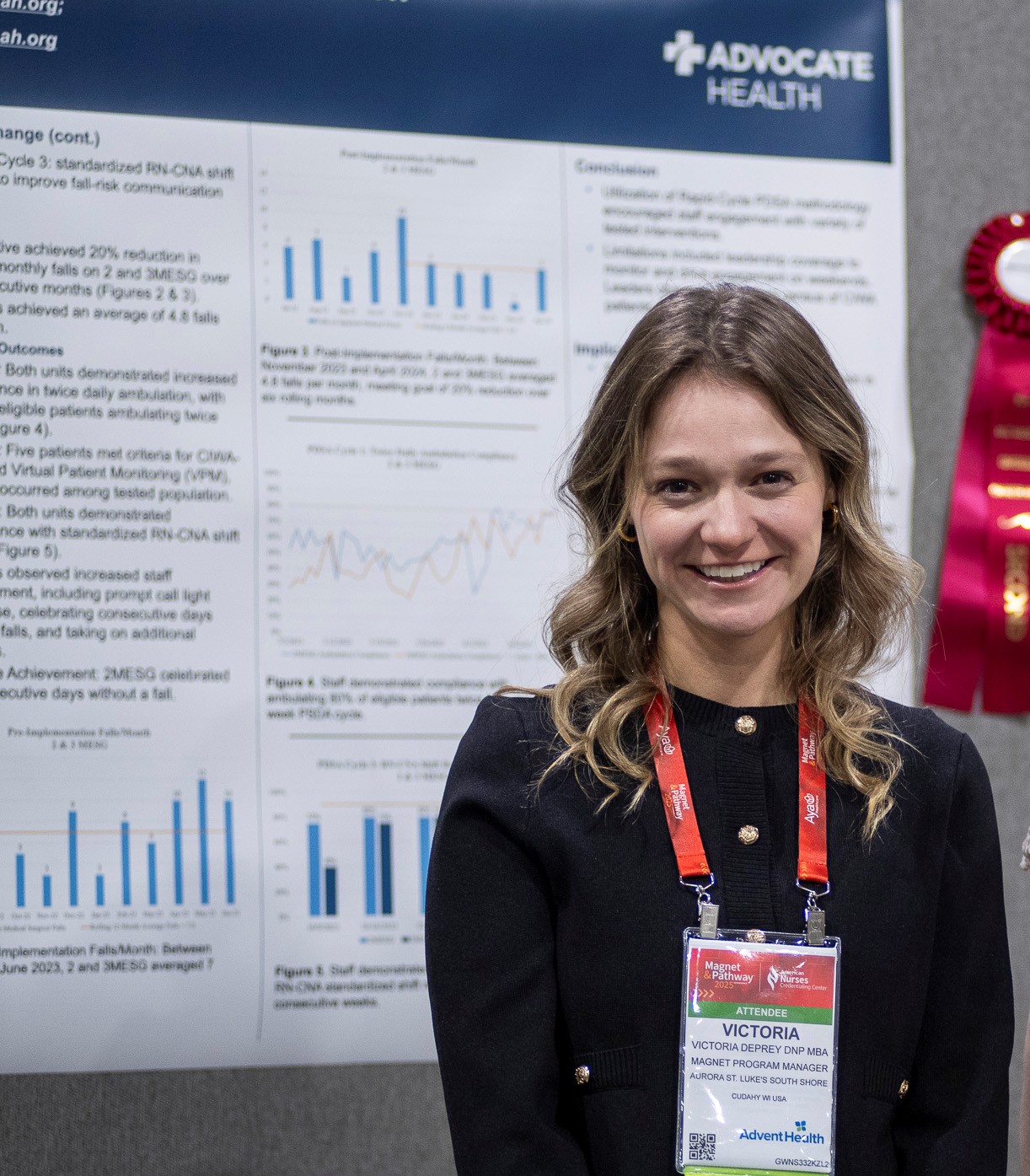
DePrey added that she is often asked if she gets the same sense of reward that she felt when she worked at the bedside, and notes that it’s rewarding at a different level, saying, “I get to support novice to expert nurses in their pursuit of nursing excellence, whether through advancing our nursing strategic plan, individually mentoring nurses, or elevating the voice of nursing to the boardroom.”
As her career continues to evolve, DePrey’s journey reflects both the power of bedside experience and the lasting influence of nurse leaders who shape the profession at any level of practice or leadership. But, she recognizes that each nursing journey is different, and all journeys are equally important, even for nurses who decide not to pursue an advanced degree. “Going back to school can be incredibly meaningful, but it isn’t the right path for everyone—and that’s okay,” she said. “I’ve had many friends start DNP programs and ultimately decide not to finish, realizing it wasn’t the right fit for them at that time. That choice doesn’t reflect failure, but rather self-awareness. One of the most important lessons I’ve learned is to give yourself grace and flexibility. You can’t truly know if an advanced degree is right for you until you’ve spent time at the bedside. Those early years helped shape my perspective and ultimately guided my career.”
Since graduating in 2018, DePrey has been intentional about staying connected to the university. She recently became a member of the School of Nursing’s Recent Graduate and Student Engagement Committee, and she hopes to expand her involvement through joining the UW Nurses Alumni Organization board and alumni chapters in the Milwaukee area. “There is truly something so special about Badger nurses,” she says. “When I come across fellow alumni, I recognize a sense of leadership and accomplishment in nursing, and I am so grateful to be part of this community.”
Let’s Pause with Tori DePrey:
Q: What was the most challenging mindset shift you needed to make as a new nurse, and how did you work through it?
A: One of the biggest mindset shifts I needed to make as a new nurse was accepting that I was not going to be an expert nurse right away. The nurses we admire did not start as experts; they grew into those roles with time. Early on, I felt pressure to have all the answers, which was overwhelming, and I had to remind myself to stop competing with my new nurse cohort. What worked for other new nurses didn’t always work for me, and I had to realize that was okay. As a naturally competitive person (and I suspect many Badger nurses are the same), learning to give myself grace was necessary for survival in my first six months. We have the foundation for skills and critical thinking, but becoming confident requires experience and flexing those nursing muscles over time. Leaning into a mentor or a few mentors helped me greatly, I figured out that asking questions, leaning on my team, and viewing mistakes as learning opportunities helped me grow. That growth is also what shapes the “nurse gut,” an instinct that doesn’t come naturally to everyone, but is built through experience, reflection, and trusting the process.
Q: What was the biggest learning curve for you going from being a student nurse to an RN?
A: The biggest learning curve was realizing that being a nurse isn’t about having all the answers, it’s about showing up for people. As a student, the focus is often on skills, checklists, and getting things “right.” As an RN, I learned that sometimes the most important thing you can do is simply be present: holding a patient’s hand, listening, and offering reassurance. You might come into practice with strong technical skills, but learning how to truly connect with patients and families is what transforms you from a skilled clinician into a trusted nurse.
Q: What strategies do you use to leave work at work so you can unwind at the end of a stressful shift?
A: I learned early on that unwinding and truly leaving work at work is a lifelong journey in nursing. During my time at the bedside through COVID, my anxiety felt almost insurmountable, and I had to be very intentional about finding ways to decompress. One strategy that made a meaningful difference was mindfulness. I started using the Headspace app and committed to just two minutes of mindfulness before each shift. Two minutes quickly turned into five, then seven. My anxiety didn’t disappear, but it helped me refocus a wandering mind, enter my shifts with more intention, and better separate work from the rest of my life once I clocked out.
I also leaned into practical tools to manage the day‑to‑day bedside grind. Early on, I was gifted a book called, What Would Flo Do?, which focuses on the first 100 days after orientation and offers a realistic, grounded transition into independence. I carried it with me every shift, and it helped normalize challenges and boost my confidence. That experience has come full circle—today, I’m working to integrate it into our orientation program to better support nurses as they take their first steps off orientation.
In my current leadership role, work‑life balance looks different. I’m intentional about being present for frontline staff during the workday so I can mentally “close the loop” at the end of it. I prioritize in‑person connection, maintain visibility across units and shifts, and have established office hours to bundle questions and concerns. I let staff know how and when to reach me, and, while I may not always respond immediately, I reassure them their message will be prioritized. By showing up consistently and creating clear boundaries, I’m able to support our teams while also protecting time to recharge outside of work.
Q: How do you manage stress and stay calm during your shift to help you be present and provide the best care?
A: I managed stress during my shifts by focusing on preparation before I even stepped onto the unit. I’ve learned that how I care for myself directly impacts how I care for my patients and my peers. Simple things—packing my lunch, filling my water bottle, meal prepping for so I have something to eat both during and after work, and creating a calm home space—help set me up for a successful shift and significantly reduced my anxiety.
During the shift, I’ve learned to recognize when emotions are running high and give myself permission to pause, whether that’s stepping into the breakroom to regroup or finding a moment of humor with my fellow nurses. That pause took practice. Early on, I would spiral emotionally and then be hard on myself. Over time, I learned that slowing down, grounding myself, and extending the same grace to myself that I give others allows me to stay calm and present.
Q: What career experiences give you a sense of hope and purpose?
A: What gives me the most hope and purpose is working with this generation of nurses, who are far more aware of compassion fatigue and burnout, and are motivated to proactively protect their mental health. That awareness shaped my DNP project, which focused on using the Moodfit app as a real‑time mindfulness tool. The strong participation showed a real desire to not just address burnout, but to sustain well-being so nurses can stay at the bedside.
I also find purpose in working one‑on‑one with nurses as they pursue certification or consider further education. Seeing organizations increasingly value and invest in the voice of nursing gives me hope—this investment is essential to the future and stability of health care.