System Change Begins with You: Joshua Hermsdorf’s Decision to Lead
By Rebecca Jamieson
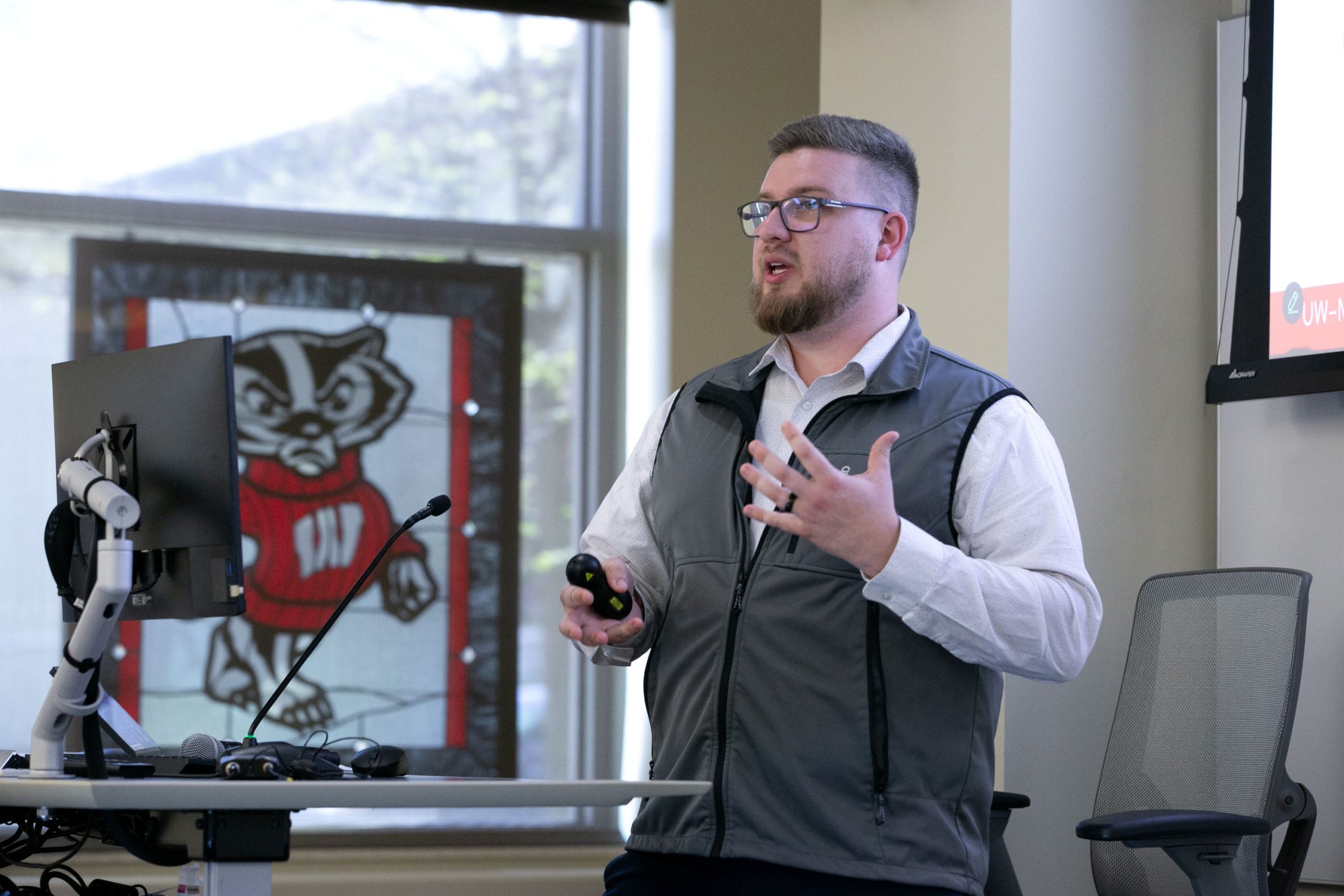
Change, whether big or small, begins in the moment when one person decides to act. For Joshua Hermsdorf, DNP’25, one of those moments came when he was working as a staff nurse in the psychiatric mental health unit at UnityPoint Meriter Hospital.
“My aha moment came when I was working at the bedside,” he says. Frustrated by the opportunities for improvement he saw but didn’t have the authority to change, Hermsdorf decided to take action.
“If I want to effect change, why not me?” he remembers thinking. “If I’m complaining about something, why not make that change myself?”
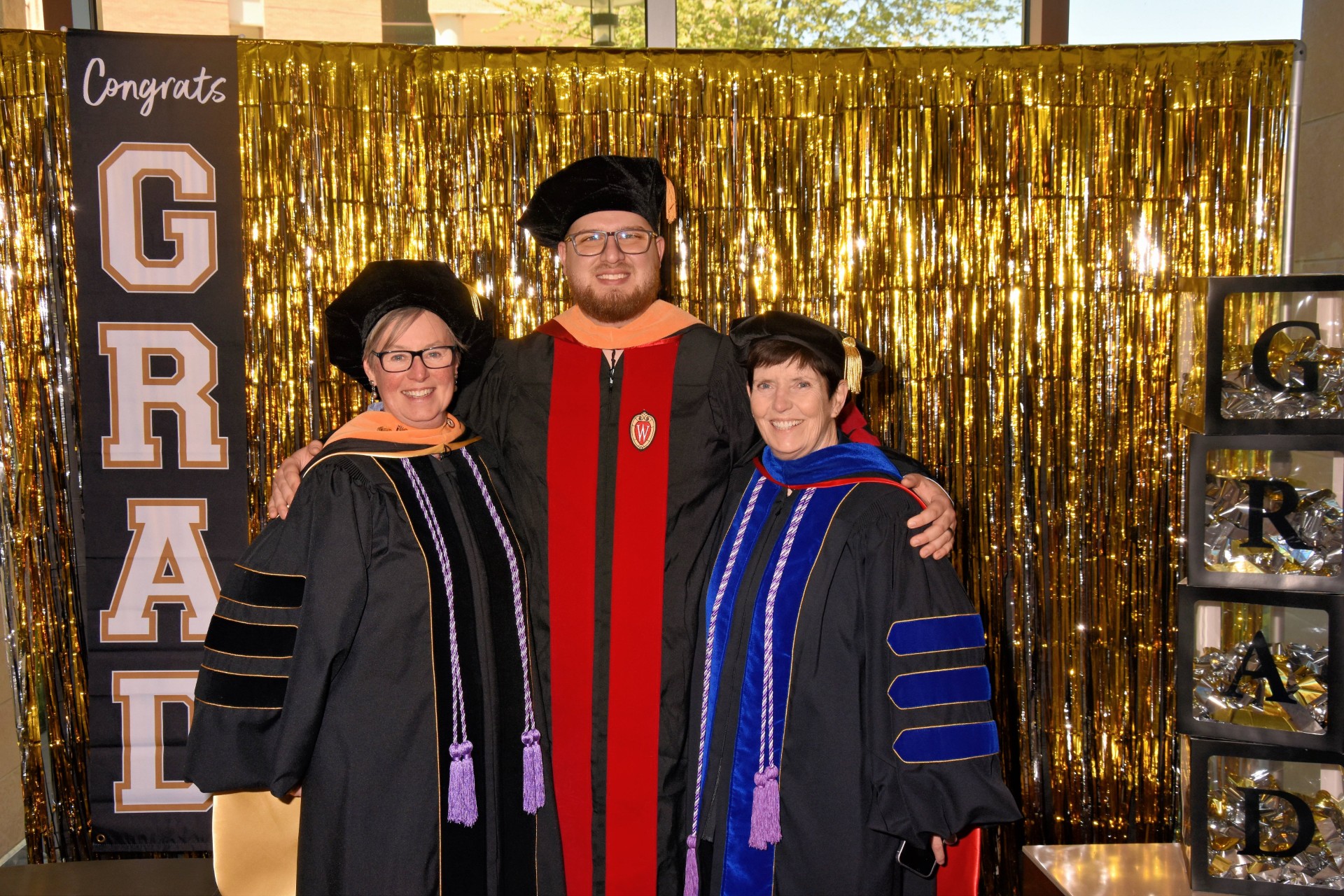
That was the beginning of Hermsdorf’s leap into nursing leadership. Currently a psychiatric nurse manager at UnityPoint Meriter, he graduated from the UW–Madison School of Nursing in 2025 with a doctor of nursing practice (DNP) in Systems Leadership and Innovation (SLI).
I fell in love with the SLI program and what it offered. It felt like it was going to help me excel in my career as a manager and continue on the way up to an executive level.
Hermsdorf didn’t start in the SLI track. He began his DNP in the psychiatric mental health track while also starting a management role in the psychiatric unit at UnityPoint Meriter. After a year in the program, his desire to transform health care on a larger scale inspired him to switch tracks.
“I fell in love with the SLI program and what it offered,” he says. “It felt like it was going to help me excel in my career as a manager and continue on the way up to an executive level.” Career advancement was a priority for Hermsdorf. “I knew the SLI program would be a catalyst for that,” he says. “It was teaching change management—exactly what I was doing but enhancing my skillset.”
For Hermsdorf, change management means asking questions like, “How do we help people grow? How do we help people treat other people?” He says, “If we can successfully manage change, we can affect patient care.”
Although the SLI program isn’t explicitly connected to mental and behavioral health, Hermsdorf says the degree was the perfect fit for him because it equips nurse leaders with the skillset to effect change.
“This program connects the dots for current leaders, future leaders, and career advancement,” he says. “It gives you the understanding of how to evaluate a system, how to look at change management, staff burnout, quality, and clinical operations.”
During his DNP, Hermsdorf completed two major projects: contributing to the Wisconsin Nurses Association Workforce Survey and evaluating new staff orientation in behavioral health. His survey work supports statewide funding and initiatives on issues like AI, pay equity, and workforce trends. His second project focused on reducing burnout and improving training, using interviews and workflow analysis to inform stronger orientation materials at UnityPoint Meriter.
This program connects the dots for current leaders, future leaders, and career advancement.
The most impactful part of the SLI program for Hermsdorf was the clinical rotations. “It’s almost like a job shadow, but much more in-depth,” he says. He worked with a chief nursing officer at UnityPoint Meriter and a senior director at UW Health. “The understanding of what they do and how they do it was so impactful on what I do day-to-day, and it also gave me a glimpse into what the future could entail,” he says.
Hermsdorf also loved how much he could immediately apply what he learned in the SLI program. “It’s real life,” he says. “It’s not just theory—you’re putting it into practice.”
Leadership has always been something Hermsdorf has gravitated towards. Growing up on a farm near Madison, he gained confidence as a leader through 4-H, sports, and helping on the farm.
His grandmother was a nurse, and she ignited his interest in health care. When both grandparents became ill, and his grandfather eventually passed away, Hermsdorf saw some of the different facets of nursing as he interacted with medical-surgical, home health, and hospice nurses.
His interest in mental health also came from early life experiences, including his cousin’s death from an overdose.
We can’t predict human behavior, but we can provide hope.
These experiences prompted Hermsdorf to become a certified nursing assistant (CNA) in high school. “I was really enamored with all the different things you could be as a nurse,” he says. “You didn’t have to be just one thing.”
Hermsdorf worked as a CNA throughout college. He studied pre-nursing at UW, but when he was waitlisted for the School of Nursing, he transferred to Herzing University and finished his BSN in 2019.
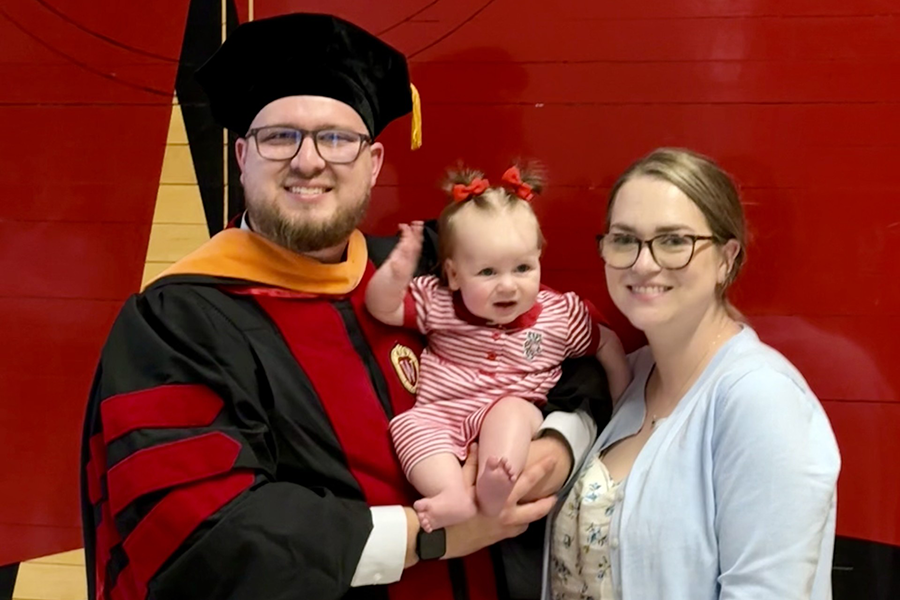
But Hermsdorf was still determined to get a degree from the UW. “Not to be cheesy, but it’s that legacy pull,” he says. Both his parents, his wife, and her family graduated from UW. “I wanted to have that UW legacy to pass along to my family,” he says. “The professionalism, the understanding, and the weight that a UW graduate degree carries were something I wanted attached to my name.”
Now that he’s achieved that dream, he has advice for students who want to transition into nursing leadership: “Find your passion. Charge nurse roles and committees are great places for change management,” he says. “Making that jump is personal, but the SLI program sets you up for success.”
For Hermsdorf, being a nurse leader means looking at the whole scope of health care—including everything from fiscal responsibilities to patient care. “I’m very happy to come to work because I know I’m affecting change on a system level and a unit level, and it changes the care we provide for our patients,” he says. “I’m super proud of where I am and what we’re doing.” His team is also part of what allows him to succeed. “Being part of that crew is what I really enjoy.”
Shooting for the stars provides drive for me. To be the best person I can be every single day helps me strive towards that level.
Even though health care is full of challenges, Hermsdorf still finds many reasons for hope. “Hope is knowing we’re putting in our best every day. There are so many advancements—medical, IT, AI—that give me hope we can create a better system,” he says.
“In behavioral health, what gives me hope is seeing patients be vulnerable—coming in for help on one of their worst days and being able to see them progress.”
Hermsdorf says it’s also important to accept that we’re only human, and that health care—and behavioral health—are ever‑evolving. “We can’t predict human behavior, but we can provide hope.”
When thinking about his future career trajectory, Hermsdorf is aiming high. “I would love to be a CEO or a president, to be able to effect change on a systems level and understand different scopes and practices,” he says. “I know I have a long way to go to get there, so right now, my ambition is to be a director. But shooting for the stars provides drive for me. To be the best person I can be every single day helps me strive towards that level.”