Nursing Through a Different Lens
Will Joyce’s Journey to Nursing
By Liz Fitzpatrick
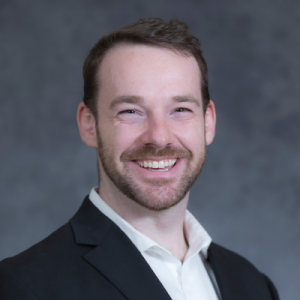
For Will Joyce ’25, the nursing journey wasn’t linear. After years in the classroom and time spent traveling through Europe, he had what he calls an “epiphany.”
“I was a teacher in my first career, and I’ve always had a passion for nurturing,” Joyce says. “I wanted to combine my passion for really caring for humans in a holistic sense.”
Joyce is living proof that it’s never too late to pivot—and that the best nurses might come from unexpected places.
As an adult learner, Joyce sought a program that would value his life experience. He found that in UW–Madison’s accelerated bachelor of science in nursing (ABSN) program, which is designed for students who already hold a bachelor’s degree in another field.
[In the accelerated BSN program] you get close on an accelerated timeline—no pun intended. You’re sitting next to each other through hard classes, long clinicals, and tough days. You have no choice but to bond.
“The accelerated program here at UW–Madison caters to people who are in a situation like mine. People who may have come from another career or may have another degree,” says Joyce. “That’s what I love about it. . . it pulls people from so many different backgrounds, which is what I think health care should be. I think it should be a melting pot of people from different careers, people from different perspectives.”
The ABSN program is intense. It compresses a traditional nursing degree into just 12 months. But that intensity forges a deep, lasting community.
“You get close on an accelerated timeline—no pun intended,” Joyce laughs. “You’re sitting next to each other through hard classes, long clinicals, and tough days. You have no choice but to bond.”
Joyce is candid about the mental health challenges that come with such an intense program and advocates for self-care practices. For him, that means running, walking, and reconnecting with the routines that ground him.
People bring in perspectives I never would have thought of. Whether your first degree was in a foreign language or poli sci, you’re able to connect with patients in unique ways.
The closeness of the community, he says, is what sustains students through the program’s most challenging moments. “It’s cool to know everybody more holistically as a human,” he adds. “That’s what makes this community so special.”
One of the most powerful aspects of the ABSN program, Joyce says, is the diversity of its students—not just in terms of race or background, but in life experience. His fellow students studied political science, Spanish, social studies, and some had backgrounds as certified nursing assistants (CNAs).
For Joyce, this diversity isn’t just a nice-to-have. It’s essential to better care.
“People bring in perspectives I never would have thought of,” Joyce explains. “Whether your first degree was in a foreign language or poli sci, you’re able to connect with patients in unique ways. For me, being a teacher taught me how to educate patients, how to meet them where they are. That’s a huge part of nursing.”
Even after long days and tough clinicals, Joyce still finds joy in the work. He smiles, thinking about the bike rides across campus, the friendships forged, and the patients helped.
For Joyce, the heart of nursing is simple: never forget the human.
“I try to stay grounded in that,” he says. “Gratitude. Purpose. The human in front of me.”
That mindset, he believes, is what helps nurses stay resilient through the emotional and physical demands of the job.
He believes that when nurses bring their full selves—their past careers, their cultures, their perspectives—to the bedside, patients benefit.
Since graduation this spring, Joyce’s next chapter is already unfolding. He accepted a job in southern Oregon and hopes to eventually work in hospice and palliative care. “One of the most empowering things you can do is give someone choice at the end of their life,” he says. “That’s where I want to be.”
He also aspires to become a licensed massage therapist and combine that with his nursing skills to offer holistic, patient-centered care.
When asked what he hopes the future of nursing looks like, Joyce doesn’t hesitate.
“I hope it looks like the ABSN program,” he says. “A diverse group of people from all backgrounds, all cultures, all career paths. That’s what our country looks like. Our health care should reflect that.”