Meet Jessica LeClair: Assistant Professor
All photos courtesy of Jessica LeClair.
Tell me a fun fact about you.
A fun fact about me is that I was involved in theater and dance for the first two decades of my life. I did all types of theater—musical, Shakespeare, and comedy. I was involved since I was about nine years old, all the way through my first college degree. I can’t sing, but I can dance! If we need a quick break in the classroom, I’ll just have people shake out, and I’ll get silly. I have no problems getting silly in the classroom.

What do you enjoy about your work at the school?
I really love the supportive community here. I love the students I work with, my peers, and the ongoing mentorship I’ve received throughout my career. I got my second undergraduate degree here, came back as a clinical faculty member, then became a PhD student, postdoc, and now tenure track. The mentorship has been phenomenal, and I’m inspired to pay that forward. I love to stay in touch with graduates, support their work in practice settings, and watch them grow, flourish, and become leaders.
The mentorship has been phenomenal, and I’m inspired to
pay that forward.
What is your favorite insider tip?
I would tell people new to the School—students or faculty—not to be afraid to open up and ask questions. Everyone is so supportive and wants to help each other succeed. If you have a question, someone else probably does too. Everyone is really friendly.
What is your specific focus in nursing? Did anyone inspire your focus?
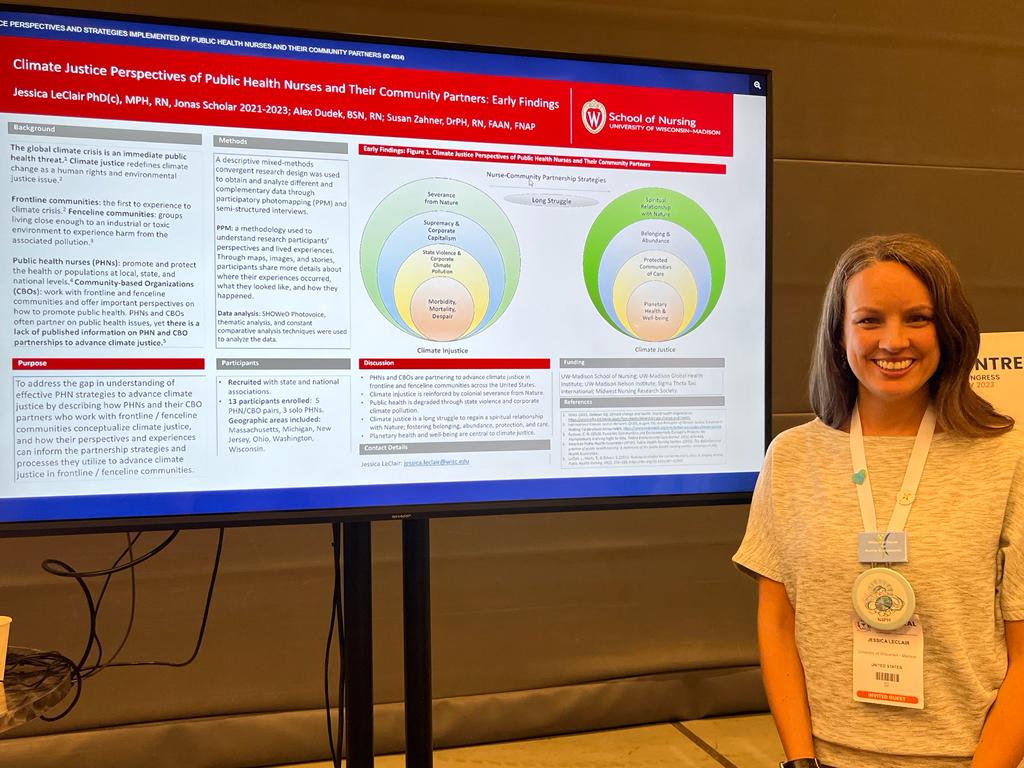
My focus is public health nursing. I returned about 20 years ago to get my bachelor’s degree to become a public health nurse. Through the honors program, I was paired with Dr. Susan Zahner, who recently retired, and her research on local public health partnerships inspired me to consider the essential need for partnerships. Collaborations with others in public health, in other disciplines, and in the communities are essential to co-create the conditions that promote health. That has been my guiding light.
Collaborations with others in public health, in other disciplines, and in the communities are essential to co-create the conditions that promote health.
Why did you know you wanted to go into public health?
My first degree was in environmental studies, theater, and English. In environmental studies, we learned that people care for their environment when they feel a sense of belonging. If they are connected to their neighbors and their community, they feel safe. They want to stay and care for the environment
That care for place and people led me to public health, which promotes healthy people and places. Public health nurses are on the frontline in communities where people don’t have access to nourishing relationships with the places where they live. I wanted to work with people in communities to co-create health, which led me to public health nursing.
Tell me about your career path and what led you to work as an educator at UW–Madison.
I was inspired as a student here to become a leader in nursing. In practice, I saw that nurses weren’t always seen as leaders, especially around issues like climate change. I worked with a community that wanted to create healthy opportunities for youth. We found youth were missing school and getting sick due to mold from flooded basements. When I raised this in public health, it wasn’t taken seriously as a public health issue.
With support from my mentor, I became a nurse educator to inspire and educate future nurses. I wanted to integrate climate justice and planetary health into nursing curriculum, so nurses have the knowledge and skills to address these threats. I wanted to help nurses feel confident in their leadership.
Tell us about your work in planetary health and your journey into research.
My work centers on integrating planetary health equity into public health nursing practice. I first became aware of climate change’s health effects as a public health nurse.
I wanted to help nurses feel confident in their leadership.
I joined the School of Nursing in 2018 to integrate evidence-based planetary health content into the classroom. But I couldn’t find empirical evidence. With mentorship and support, I entered the PhD program to build that evidence and was able to apply what I learned directly in my teaching. It was a win-win.
My research is practice-based, working with nurses, health departments, and communities to address climate change, pollution, and biodiversity loss.
How can someone at the School get involved with planetary health? How can someone outside support it?
You can’t have healthy people on a sick planet. Climate change, pollution, and biodiversity loss severely impact health. These issues affect the individuals, families, and communities that nurses serve.
Everyone has an important role in promoting planetary health. Whether you’re reducing carbon output in hospitals, partnering with communities, or working in transportation systems, everyone can contribute.
You can’t have healthy people on a sick planet.
In research, you can explore how climate change affects your population and integrate that into your work. In education, planetary health is being threaded through all levels of our curriculum. Our students are also involved in the Planetary Health Report Card, a global student-led initiative assessing how schools are doing. Others engage through advocacy and community partnerships. For example, we have a lot of community partnerships in supporting the work that they’re doing around environmental justice or climate justice work.
After earning your PhD, you became a postdoctoral trainee here at UW–Madison. What has it felt like to grow your research program as a postdoc?
What makes the postdoc position unique is the direct pairing with a research mentor. Not all schools offer that. I’ve had the freedom and mentorship to grow my own research program, which I feel very lucky to have. It feels like unleashed creative freedom. I want all nurses to feel that way. They should have the creative freedom to decide with their community partners what works best and to try things out. It feels like unleashed creative freedom. I want all nurses to feel that way.
Planetary health is a global issue, but its effects and solutions are local, sometimes down to the specific block or neighborhood that you’re living in. Nurses need time and freedom to build authentic relationships and co-create solutions with communities. I’ve been given that here, and every nurse deserves it.
It feels like unleashed creative freedom. I want all nurses to feel that way.
How does your role contribute to the Wisconsin Idea?
I do practice-based research with local communities and public health systems, including alumni now working in those systems. My research supports their practice in integrating planetary health, and there’s growing interest and support for this work. I’m really excited to see how it grows.
LeClair wants to ensure every nurse feels empowered to lead, collaborate, and create meaningful change through nursing research. Learn more about our PhD in Nursing program.