A Badger Nurse Bond Built Through Mentorship
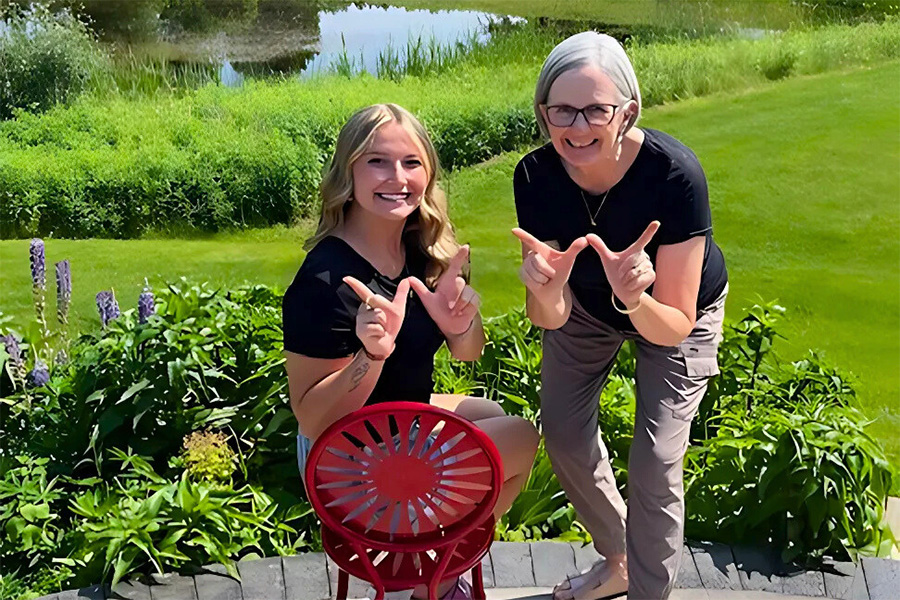
At the University of Wisconsin–Madison School of Nursing, the spirit of connection runs deep. It’s a community where tradition meets transformation, the past meets the present, and where generations of Badger nurses are linked not just by their education, but by a shared commitment to transforming the future.
By Megan Hinners
“I know it sounds like a cliché, but I’ve wanted to be a nurse since I was a child,” says Emily (Peck) Mroczynski ’80. With no health care professionals in her family, her passion for nursing is rooted in a desire to listen, connect, and care. Over her 45-year career, Emily has served in many roles, including labor and delivery nurse, school nurse, and lactation consultant. Each role deepened her understanding of what it means to practice nursing and to change the lives of those around her.
Some of her most memorable moments came early in her career. She recalls one unforgettable moment: “As a young labor and delivery nurse, I delivered babies on my own when they were not going to wait for the physician. My hospital didn’t have residents at the time, and I worked nights, so it happened more than once.”
“It was before epidurals were common,” she adds, “so it was a lot of hands-on nursing care.” Later, as a school nurse, she built long-term relationships with children and families, becoming a trusted presence in their lives. And today, as a lactation consultant, she helps new mothers find confidence in their first steps of parenthood.
The call to care was also answered by Gracie DeKeyser ’25. While DeKeyser’s path at the beginning of her nursing journey differed from Mroczynski’s, her passion for the profession is just as fierce. “Being able to care for others during stressful times and aid in their healing is one of my greatest privileges,” says DeKeyser.
Drawn to the opportunity to connect with and advocate for her patients, DeKeyser arrived at UW–Madison with dreams of becoming a health care provider. “Although I knew I wanted to be a nurse and attend the UW–Madison School of Nursing as an incoming freshman, my path turned out to be a little different,” she says. “Coming into college with a great amount of college credit from high school, I was able to get ahead in my college career.”
Knowing she wouldn’t be accepted into the School of Nursing until at least her third year at UW–Madison, DeKeyser pursued a separate degree first. She powered through to earn a bachelor of arts in communication sciences and disorders with a certificate in gender and women’s studies in just three years before applying to the School of Nursing’s accelerated bachelor of science in nursing (ABSN) program.
Despite the intensity of the twelve-month ABSN program, DeKeyser thrived. “The professors and faculty put forth their best effort to ensure our preparedness,” she says. “It was hard, but it taught me to be confident and to enjoy what I’m doing.”
Still, she admits it was challenging at times. “Being a part of a very quick twelve-month program in a realm that I was very unfamiliar with, I felt very overwhelmed,” she admitted. “Juggling classes and clinicals was hard enough, so throwing in application building and job searches into the mix made for a very stressful year.” That’s when she discovered the Badger Nurse Mentorship Program, a School of Nursing initiative that pairs students with alumni mentors.
Meanwhile, Mroczynski, who had already mentored several students through the program in years prior, was eager to get involved for another year. “The hard-won wisdom and experience you can share with a student can be a confidence booster to this next generation of nurses,” she explains. “Being a mentor is one more fantastic way to stay current, stay involved, and pay it forward to the next generation of Badger nurses.”
The two were paired up in the program early in the 2024-25 academic year, and the match could not have been any more perfect. “I was able to be paired with an incredible woman,” Dekeyser says. “She lives in the same area I’m from, worked as a nurse in my high school, and started at — and still works at — the hospital I wanted to work for.”
Their relationship quickly grew beyond scheduled check-ins, and Mroczynski has tapped into her past experiences of relationship building and being a guiding force to help DeKeyser navigate the transition from being a nursing student to being a practicing nurse in the workforce, providing advice on job applications, offering to be a reference, and even inviting DeKeyser to shadow a lactation class she teaches. “That experience was huge for me,” DeKeyser says. “I’m really interested in labor and delivery, and being able to see that side of nursing firsthand was incredible.”
Mroczynski, who has been involved with the Badger Nurse Mentorship Program for the last four years, has found the experience of participating in the Badger Nurse Mentorship Program deeply rewarding. “I get so much back from them,” she says of her mentees. “It helps keep me current with what’s new in their education as well as what today’s job market looks like.”
Even after the program officially ended, the connection Mroczynski and DeKeyser have formed endures. “Emily continues to look out for me and my future by providing me with incredible opportunities to grow my career as a nurse,” DeKeyser says. “She’s still acting in that mentor role for me by just being a person to rely on and be there when I need.”
Now that DeKeyser has moved back to Green Bay, the two meet for coffee and continue to support each other. “I believe the first year of nursing can be very stressful,” Mroczynski says. “My hope is I can be a help to Gracie as she makes the transition. I’ve told her that this job is the one where she will gain confidence in her nursing skills, and every door is open to her professionally. I look forward to watching her career take off; I appreciate that we can now keep in touch in person.”
DeKeyser, now working on the medical unit at Bellin Memorial Hospital (soon to be Emplify Health) in Green Bay, is already thinking about the future and how she will be able to give back when the time is right. “Absolutely, I want to be a mentor,” she says. “I would love nothing more than to be that person for other nursing students just like me. I am so thankful for what the Badger Nurse Mentorship Program was able to offer me as a mentee, and I can’t wait to one day be a Badger Nurse Mentor myself!”
The Badger Nurse Mentorship Program is more than a networking opportunity; it’s a chance to build a lasting connection. For students, it offers guidance, reassurance, and real-world insight. For alumni, it’s a chance to give back, stay connected, and shape the future of nursing.
Both DeKeyser and Mroczynski are strong advocates for the experience. “I highly encourage nursing students to participate,” says DeKeyser. “It’s life-changing.”
“I wish I would have had a mentor when I was in school,” Mroczynski reflects. “It would have been both reassuring and helpful. Nursing school is difficult, and being a nurse is not easy. I believe strongly that we need to support each other to get through school and then every day in the workplace.”
As health care continues to evolve, one thing remains constant: the strength of the Badger nurse bond. In a world that often feels disconnected, the Badger Nurse Mentorship Program is fostering a community of connection — one conversation, one coffee, one shared story at a time.